
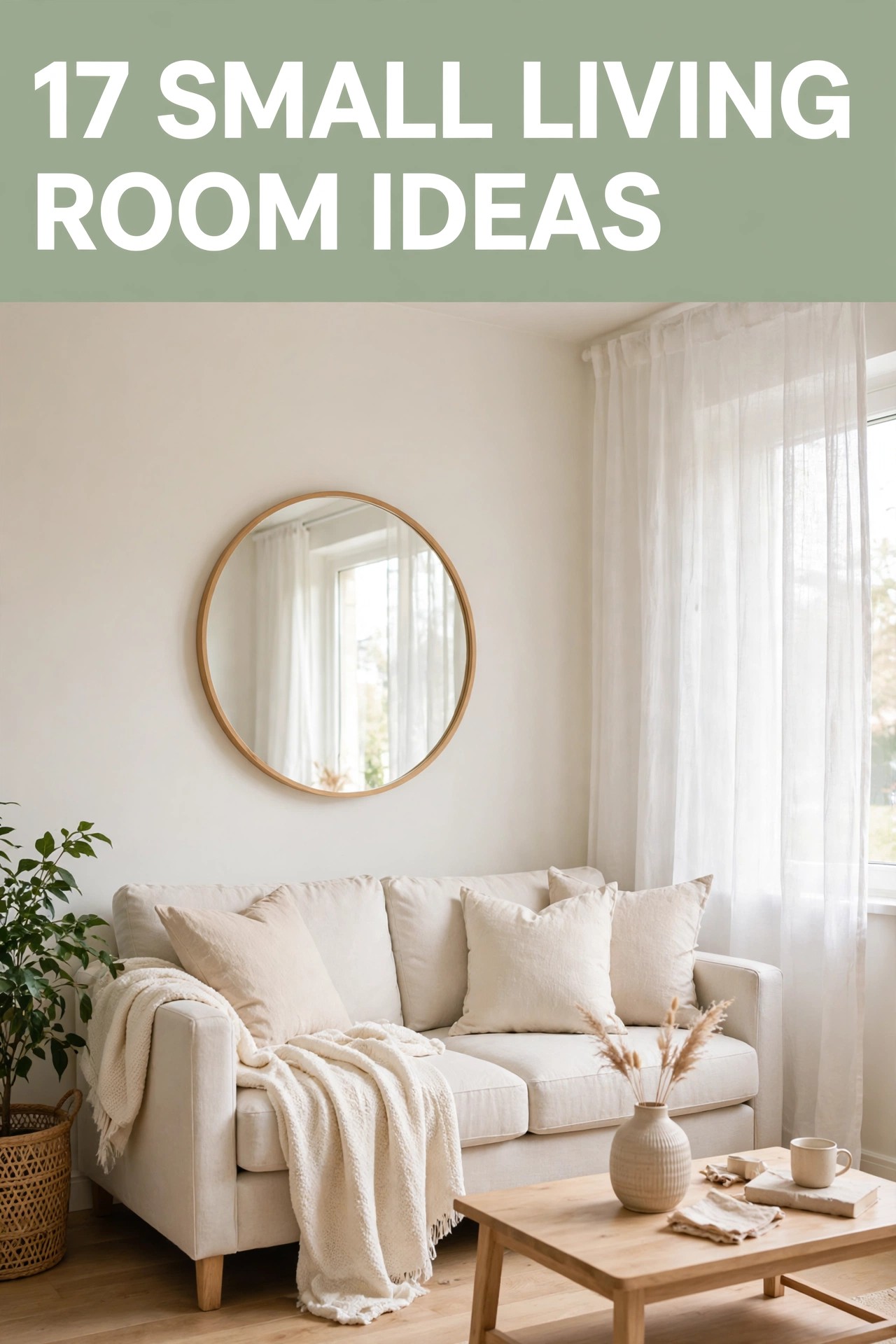
17 Small Living Room Ideas That Make a Tiny Space Feel Twice as Big
Most small living rooms aren’t actually that small. They just look small, because the furniture is too big, the curtains hang too low, and every dark corner is busy swallowing light. I’ve spent way too long looking at tiny apartments (and lived in a 480 sq ft one myself), and the rooms that feel twice their size all cheat in the same handful of ways. None of them require knocking down a wall. Most cost under fifty bucks.
Here are the 17 tricks that actually work, roughly in the order I’d do them.

1. Hang your curtains at the ceiling, not the window frame
This is the single fastest fix on this list. When curtain rods sit right above the window frame, your eye reads the wall as short. Move the rod up to within two inches of the ceiling and let the curtains fall to the floor. The wall suddenly reads as tall, and a tall room always feels bigger. Sheer white or linen panels do double duty, they let light through while hiding an ugly view.
2. Put a big mirror across from the window
Not a tiny decorative one. Go bigger than you think, 24×36 inches minimum. Hang it on the wall opposite (or adjacent to) your main window so it catches daylight and throws it back into the room. You’re literally doubling the light and adding a fake “view.” Ikea and HomeGoods both sell large framed mirrors in the $40–$70 range that look far pricier than they are.
3. Swap the chunky sofa for one with legs and low arms
A sofa that sits flush on the floor in a dark fabric is a visual black hole. Raised legs let you see the floor underneath, and visible floor = perceived space. Low arms (or no arms) stop the sofa from boxing in the room. If a new sofa isn’t in the budget, even swapping to light-colored throw covers and lifting the front on 4-inch furniture risers helps more than you’d expect.
4. Use one big rug instead of two small ones
Small rugs chopped into zones make a small room feel even choppier. One large rug (at least 5×7, ideally 8×10) that reaches under the front legs of the sofa and chairs pulls everything into one generous area. Light, low-pile rugs in cream, oatmeal, or pale gray make the floor plane look wider.
5. Pick a glass or acrylic coffee table
See-through furniture barely registers visually, so the room keeps its sightlines. A glass-top table, a lucite side table, or even a light open-frame metal table will make the center of the room feel airy instead of parked. No budget for new furniture? A light wood table with slim legs beats a solid blocky one every time.
6. Paint it one light color, walls, trim, everything
Contrasting trim is charming in big houses and choppy in small rooms. Painting walls, baseboards, and door frames the same soft white or warm greige removes the visual “frame” around every surface, so the walls seem to recede. You don’t need pure white, warm off-whites (think Benjamin Moore White Dove or Behr Swiss Coffee) feel cozy, not clinical.
7. Float the furniture off the walls
Counterintuitive, but true: pushing every piece flat against the wall doesn’t make a small room bigger, it makes a dead border around a cramped center. Pulling the sofa even 3–5 inches off the wall creates a shadow line that reads as depth. If you have one layout option only, angle nothing, angles eat floor. Straight lines, floated slightly, win.
8. Trade table lamps for wall sconces
Every lamp on a side table steals surface and floor space. Plug-in wall sconces (no electrician needed, most come with a cord cover) free up the tables entirely and push light up the walls, which makes ceilings feel higher. Renters: 3M strips won’t hold them, but a single small screw hole is usually fine, and spackle costs three dollars.
9. Go vertical with storage
Floor space is the currency of a small room; wall space is free. Tall, narrow bookcases (30 inches wide, 6 feet tall) hold as much as a wide dresser in half the footprint. Floating shelves above the sofa or beside the TV draw the eye upward, and upward is where your unused space lives.
10. Choose one statement piece, keep the rest quiet
Small rooms die by a thousand decorative cuts. One bold thing, a patterned armchair, an oversized art print, a vintage rug, gives the room personality. Everything else in calm neutrals gives the eye a place to rest. When everything shouts, the room feels chaotic and small.
11. Hide the clutter in closed storage
Visual clutter shrinks rooms faster than furniture does. Open shelves full of remotes, chargers, mail, and random boxes make your brain read the room as full. Swap to storage with doors or baskets with lids: an ottoman that opens, a console with cabinets, woven baskets on the open shelves you already have. Out of sight genuinely is out of mind here.
12. Hang art higher and bigger than feels safe
Small art hung at eye level in a cluster reads as clutter. One large piece (or a tight pair) hung so its center is around 57–60 inches from the floor stretches the wall. If you’re doing a gallery wall, take it nearly to the ceiling, the top of the arrangement is what sets the perceived height of the room.
13. Keep the color palette to three colors max
One main color (60%), one supporting color (30%), one accent (10%). That’s the whole rule. A tight palette makes a small room feel deliberate instead of accidental, and deliberately styled rooms always read larger. This is also why hotel rooms, usually tiny, feel calm: they’re ruthless about palette.
14. Let the legs show on everything
Skirted sofas, floor-length tablecloths, cabinets that sit on the ground, they all cut off sightlines. Mid-century-style legs on sofas, chairs, TV stands, and sideboards let you see floor stretching underneath, and your brain measures the room by visible floor. If you’re buying anything new for a small living room, “does it have legs?” is the first question.
15. Ditch the overhead light as your only light
A single ceiling light flattens everything and pools brightness in the middle, leaving corners dark, and dark corners shrink the room. Layer three light sources at three heights instead: something high (a floor lamp), something mid (sconces or a table lamp), something low (a small lamp or candle glow on a shelf). Lit corners make the room’s full footprint visible at night, which is when most of us are actually in there.
16. Mount the TV and lose the media console
A TV stand is one of the bulkiest pieces in any living room, and it doesn’t need to exist. A $25 tilt mount puts the TV flat on the wall, and a slim floating shelf underneath holds the remote box and console. You just gained back roughly 6 square feet of floor, in a 120 sq ft room, that’s five percent of your entire space.
17. Leave some emptiness on purpose
The hardest one. A small room needs breathing room, one bare wall section, one clear surface, one corner with just a plant. Negative space is what makes the styled parts look styled instead of stored. When every inch is filled, the room feels like a warehouse no matter how pretty the pieces are.
Where I’d start this weekend
If you’re doing three things, do these: curtains to the ceiling (#1), the biggest mirror you can afford across from the window (#2), and clear every surface into closed storage (#11). That’s a Saturday afternoon and maybe $100, and it’s the combination that changes how the room feels, not just how it photographs.
Small rooms aren’t a limitation, honestly. They’re a tighter brief. Get the light and the sightlines right, and a 10×12 living room can feel like the calmest spot in the house.
Save this for your next free weekend, and follow Small Space Bliss for a new small-space idea every day.